Interview with Stefan Ivarsson on Region Värmland's Energy Supply and Partnership in SESBC
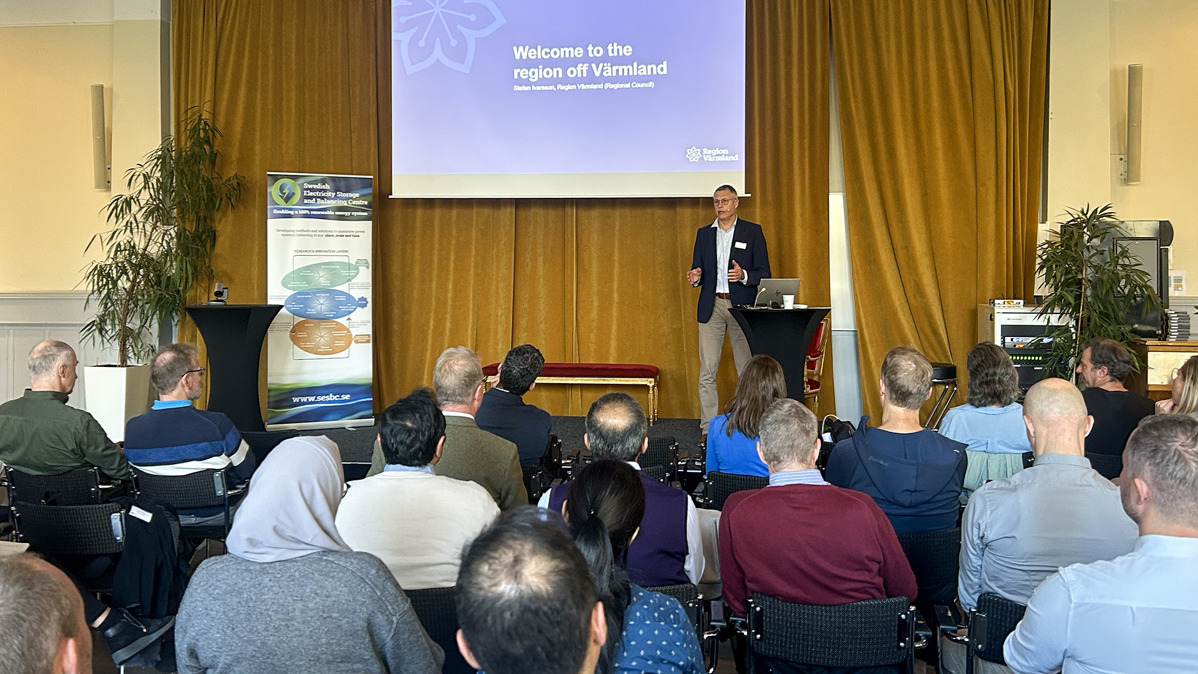
Next year, Region Värmland will join the Swedish Electricity Storage and Balancing Centre (SESBC) as a partner. Stefan Ivarsson, Regional Development Strategist at Region Värmland, was invited to speak at this year's centre conference in Karlstad. We took the opportunity to ask him a few questions.
Stefan, why has Region Värmland decided to join SESBC?
"We see the issues that the centre addresses, such as energy storage, balancing and flexibility solutions that strengthen the power grid, as highly relevant to our business community. In a broader context, given today's increasingly uncertain global situation, resilience has become more important than ever. Värmland's geographical location between the Stockholm-Mälardalen region and the Oslo region has increased the focus on infrastructure, especially energy infrastructure, and the importance of strengthening it across this corridor. We are also very pleased that Karlstad University is part of the centre. The expertise being developed locally in Värmland is a major reason why we, as a region, want to be part of this collaboration."
What do you hope will come out of the centre's work?
"Naturally, we hope to see highly qualified researchers and exciting results that advance our understanding of how energy storage, flexibility and grid balancing can be used to create a more efficient, stable and resilient energy system. The next step is to bring this knowledge into practice through dialogue with grid operators and energy companies, and together build a strong and sustainable region.
How do you view the relationship between research and practical implementation?
"We understand that research operates at different levels and requires many perspectives. As a region, however, we are primarily focused on the system level and on how to create solutions that work in society. One of the major gaps I see is that research often focuses on technical functionality, while there is also a need to integrate these solutions into systems that are commercially viable. A good example is emergency energy storage that can be used during crises. Who will pay for maintaining such storage capacity during peacetime? If no one is willing to pay for it, no one will build it. We can conduct extensive research on the technical functionality, but if the business model is missing, the solution will never find its place in society. Bridging the gap between technology and commercial structures is one of the key challenges I see, and something I actively advocate addressing."
How do you see Värmland's energy supply today and in the future?
At present, we face a somewhat strained situation due to bottlenecks in both the transmission grid and the regional grid. We look forward to these challenges being addressed, although it will take time. In the meantime, stakeholders in Värmland need to explore solutions such as energy storage, which can help manage short-term peak demand without requiring immediate grid expansion. This makes the field particularly interesting for our industries and businesses. Once the major infrastructure projects are completed and additional capacity becomes available, I believe Värmland will be in a very strong position in terms of energy supply.""
What specific challenges does Värmland face?
"One challenge is increasing energy production within the region. Military low-altitude flight zones impose restrictions on developments such as wind power. Hydropower is already operating at full capacity, but we would also like to see greater storage capabilities. Pumped-storage hydropower inevitably affects the natural environment, while wind turbines are highly visible and require space. That is why it is essential to bring all stakeholders together and maintain an open and constructive dialogue."