Reflections on Battery Innovation Days
Niklas Thulin reflects on the 6th edition of Battery Innovation Days, held in Stockholm on 11–12 November. The event was described by one of the delegates as the ’Champions League’ for battery research and innovation funding. |
|

In mid-November I had the opportunity to attend the Battery Innovation Days event in Stockholm. After several recent failures or significant delays in especially cell manufacturing initiatives, ’reboot’ was the word of the week. Batteries are now recognized as a key solution in society, crucial for transportation, energy and defence sectors. Thus, Europe needs to become much more independent in supply chain and technology, hedge bets in both battery chemistries and applications layers, leverage strengths in industrial and systems knowledge and open collaboration and focus research and innovation in areas where European industry can differentiate globally. Access to more mature technologies (such as LFP) can be secured by selective collaboration with global players setting up production in Europe, for Europe, with European workforce. Several speakers also asked for a clearer wanted position and battery roadmap from the Commission.
Policy needs were highlighted in both industrial and market design fields. Europe needs clear, long-term rules for local content and public procurement to give producers and investors the confidence to commit capital. Public research and innovation support, especially financing for first-of-a-kind plants can help bridge technology and scale-up risks that individual companies may not bear alone. Tariffs and connection agreements should reflect the grid impact of storage, avoid double charging and enable flexible connections and local flexibility procurement. Faster permitting and grid connections, access to competitive low-carbon electricity, workforce skills and manufacturing excellence are presented as practical prerequisites for competitive production
Noted:
The European Investment Bank in a panel highlighted Battery Energy Storage Systems as the most investable part of the European battery ecosystem right now.
Swedish aggregator Ingrid Capacity presented their experiences on remaining challenges with DSOs with respect to BESS integration. As ancillary-service markets become more competitive, revenue may shift toward energy-market optimisation and local flexibility. Tariffs that fail to reward congestion relief or that penalise charging during surplus periods will undermine the system value of storage.
Energy Storage Europe highlighted how EU energy policies over the last few years have strengthened the case for storage as well as five high-on-the-agenda questions in energy security where storage has a key role to play (Adequacy, Stability, Flexibility, Resilience, and Hybrid threats). Research priorities; cost efficient solutions for storage beyond four hours, grid forming solutions at scale, forecasting and optimization for flexibility, coordinated DSO-TSO control and cybersecurity.
One delegate from Portugal whom I had lunch with described the event as the ’Champions League’ for battery research and innovation funding. Indeed, all major advisors and consultant were present at the event. There are certainly many opportunities available in Europe right now for funding battery related research and innovation.
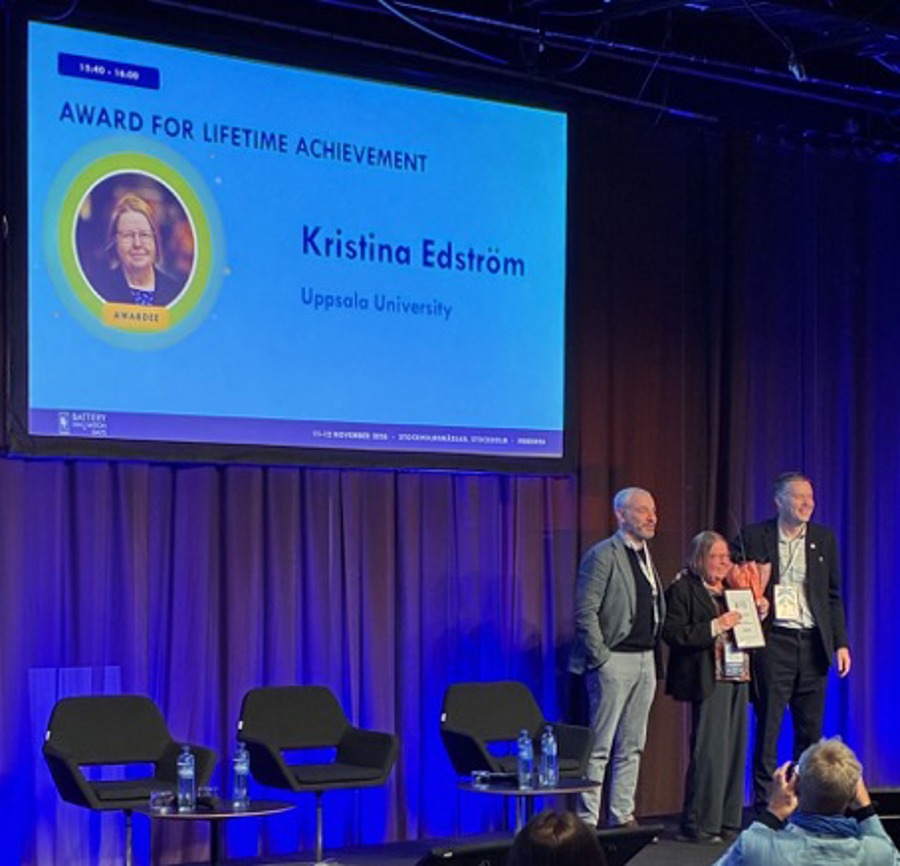
The conference ended with a heartfelt moment, a lifetime achievement award to Prof Kristina Edström at Uppsala University for her contribution to the battery field in Europe.